On Thursday, 29 January, a NEOLAiA Alliance update meeting was held at the University of Salerno for UNISA delegates and department directors.
The meeting, which lasted about two hours, was preceded by a focus on Diversity & Inclusion (D&I) issues, confirming the centrality of these values within the alliance, and by institutional greetings from the Rector Virgilio D’Antonio.
The proceedings were coordinated by Prof. Vittorio Scarano, Project Coordinator, Prof. Bice Della Piana, Scientific Coordinator, and Prof. Francesco Donsì, who presented updates on the main progress and ongoing activities within NEOLAiA. During the meeting, the main areas of intervention of the alliance were addressed, including research, teaching, third mission, involvement of technical and administrative staff, students, policy and best practice, which at this stage represent the key factors for the process of growth, transformation and internationalisation of UNISA, up to the final conclusions.
Research
The section dedicated to research featured presentations by Prof. Vittorio Scarano, Prof. Francesco Donsì and Prof. Cesare Pianese, UNISA’s research delegate. During the discussion, the progress of joint research activities was illustrated and the main opportunities for collaboration within the NEOLAiA alliance were highlighted.
Teaching
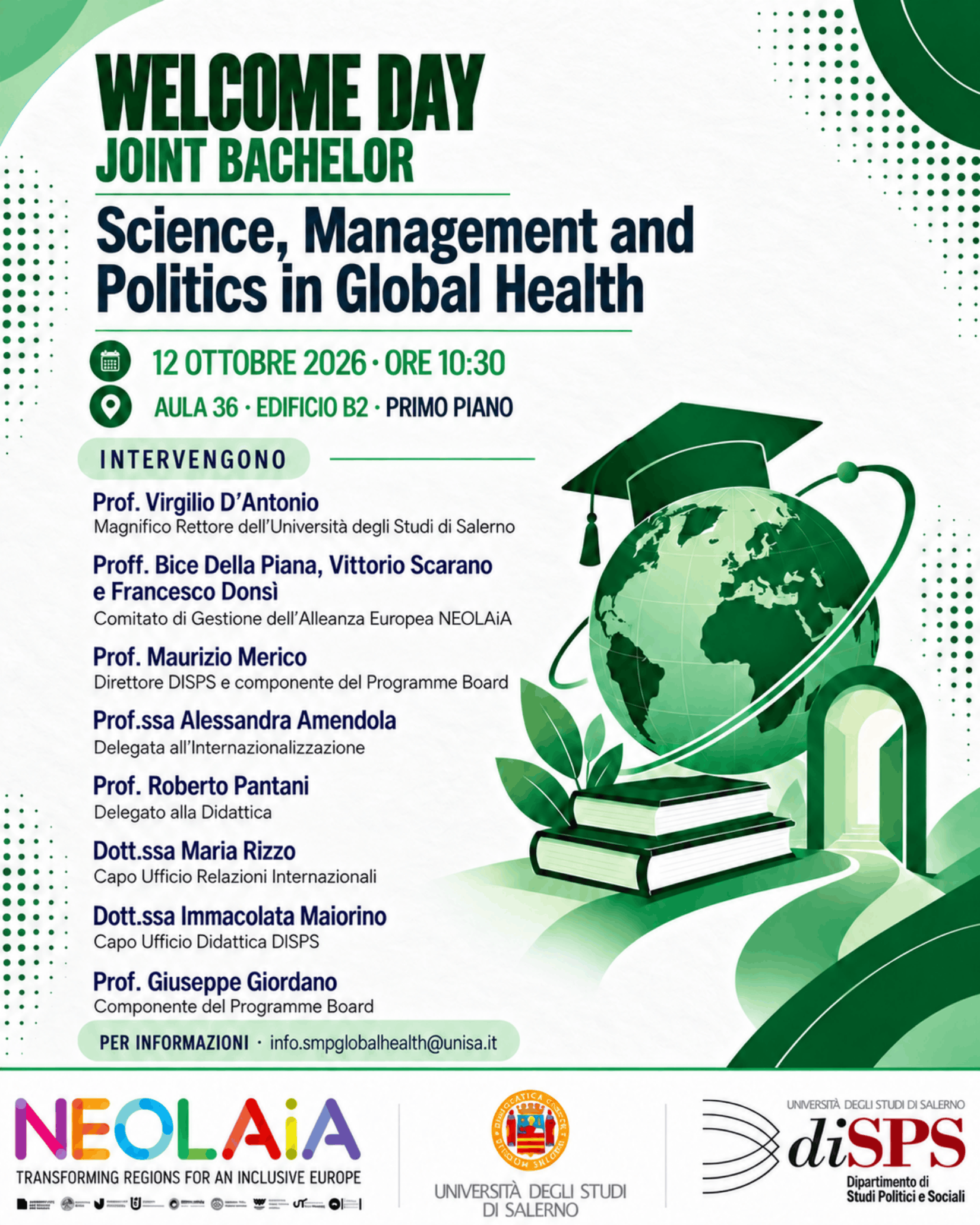
Regarding teaching, Prof. Bice Della Piana presented an update on the status of joint degrees, while Prof. Maurizio Merico illustrated the joint degree coordinated by UNISA, “Science, Management and Politics for Global Health”. Finally, Prof. Gianluigi Franci presented the Master’s in Vaccinology, developed in collaboration with the University of Örebro.
Third mission
The section dedicated to the third mission featured a presentation by Prof. Vittorio Scarano, who provided an update on activities in the field of open data and open science, living labs and scientific communication. Next, Prof. Davide Monaco presented the Citizen Science NEOCommunity@Salerno project, while Prof. Orlando Troisi, UNISA’s delegate for the Third Mission/Knowledge Enhancement and Technology Transfer, contributed to the debate on initiatives with a territorial impact.
Involvement of technical and administrative staff
Furthermore, ample space was given to the involvement of technical and administrative staff. Prof. Bice Della Piana illustrated initiatives related to staff mobility, short training before departure, the development of staff networks and the recognition of activities in career plans. Prof. Vittorio Scarano then explored actions related to HR4SR (Human Resources Strategy for Researchers) and the role of expert groups within the alliance.
Students
The issue of student involvement was central to the debate. Prof. Christian Esposito and Prof. Erika Marie Pace presented the short mobility programmes (Focus Academy), while Prof. Bice Della Piana illustrated the incoming and outgoing traineeship activities and the monitoring of cultural awareness courses. Prof. Rosangela Feola presented the SUMMA BAC Summer School in Entrepreneurship, aimed at bachelor’s students, and Prof. Vittorio Scarano concluded the session with a focus on mentorship activities for early-stage researchers (PhDs) and the NEOLAiA Virtual Campus.
Policy, best practices and conclusions
The final session, dedicated to policy and best practice, opened with a presentation by Prof. Bice Della Piana on multilingualism policy. Prof. Mariarosaria Colucciello, UNISA’s Mobility Policy Representative, announced her participation in the Symposium on Multilingualism, scheduled for June in Jaén, while Prof. Alessandra Amendola, UNISA’s Internationalisation Representative, outlined future prospects in this area. Professors Francesco Donsì and Abdelaziz Rhandi, UNISA delegate for Mediterranean Projection, also intervened. In closing, Prof. Vittorio Scarano emphasised the importance of the full involvement of all members of the University, students and teachers alike, reiterating the need to “reach our destination”, i.e. to further strengthen the internationalisation and Europeanisation of UNISA.
Conclusions
The meeting confirmed that the NEOLAiA Alliance is increasingly recognised and rooted within the University, representing a strategic reference point for the international development of UNISA. The attentive participation and constructive discussion among all those involved testify to a strong interest in the future developments of the alliance, in the awareness of the added value that NEOLAiA can continue to offer to the academic community.