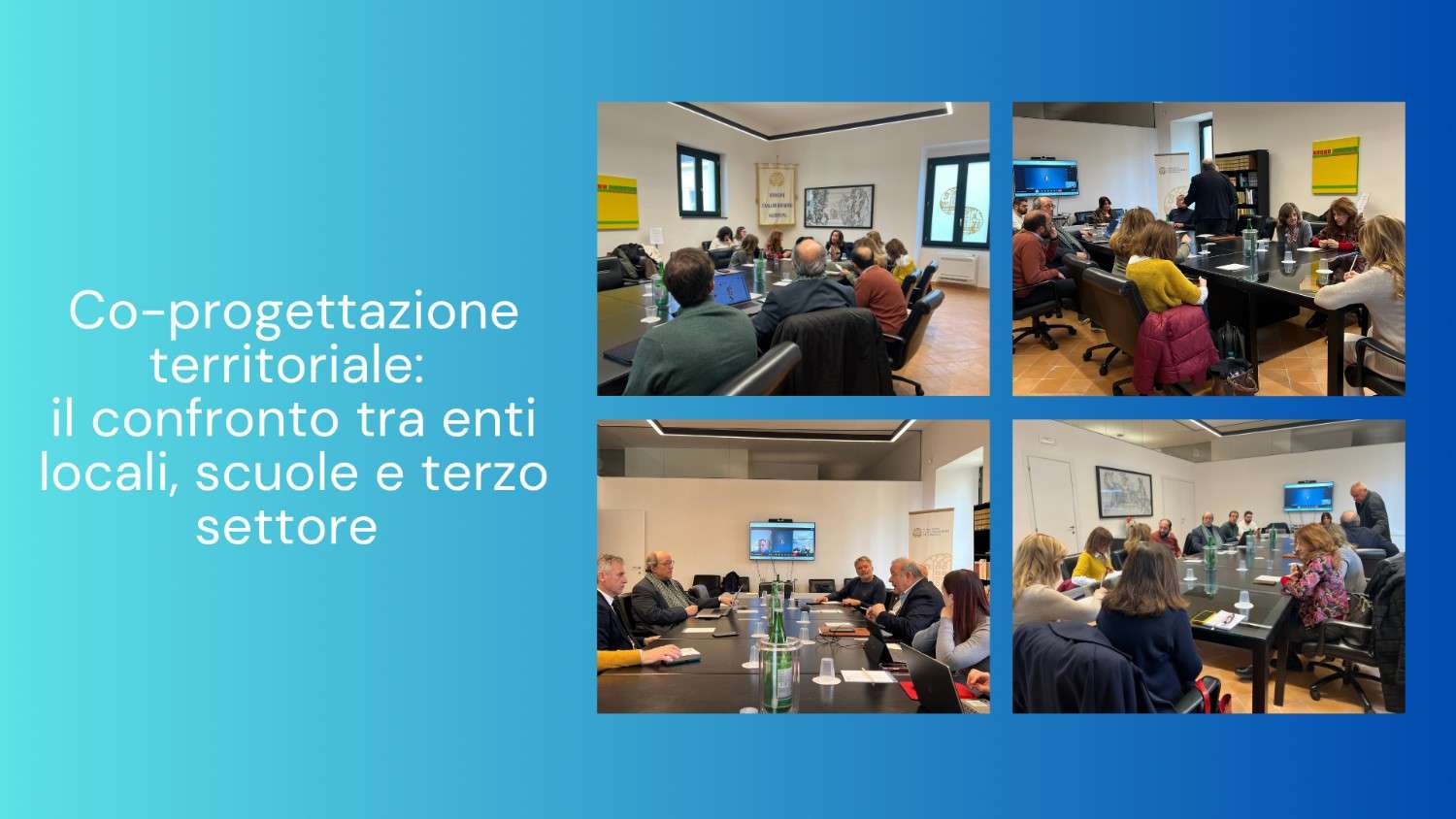
Two preliminary meetings were held on 16 and 17 March at the Carisal Foundation, involving representatives from local authorities, local schools and the third sector, marking the start of a collaboration between the Foundation, BIMED (Mediterranean Arts and Sciences Biennial) and the University of Salerno, specifically within the framework of the European NEOLAiA project. The activities to be developed over the coming months will fit into the Citizen Science actions of NEOLAiA’s WP8, with the aim of building participatory initiatives based on the real needs of local communities.
Local authorities: services, depopulation and practical needs
The first meeting brought together local government officials and institutional representatives, including Andrea Iovino, President of BIMED; Michele Buonomo, Vice-President of the Carisal Foundation and President of Legambiente Campania; Valerio Salvatore, member of the Carisal Foundation’s Steering Committee; Giovanni del Sorbo, Head of Executive Procedures for Staffetta di scrittura and BIMED Community Projects; and Vittorio Scarano, Full Professor at the Department of Computer Science, University of Salerno, and UNISA coordinator of the NEOLAiA – European University Alliance project.
During the discussion, the main challenges facing internal areas emerged clearly: a lack of essential services, difficulties with mobility, weak infrastructure and the progressive exodus of young people. The debate highlighted the need to provide concrete solutions for these areas, particularly in response to the challenges associated with the use of public funding, which is often not fully aligned with local needs.
Vittorio Scarano, NEOLAiA coordinator for UNISA, outlined the co-design model and the “double diamond” methodology, emphasizing the university’s role as a scientific institution tasked with listening to the local community and translating its needs into structured proposals.
Testimonies from local administrators, including Ettore Poti, Mayor of Controne, and Davide Aprea, Chair of the Centola Town Council, revealed widespread difficulties in ensuring adequate services, with direct consequences for the retention of families and young people in the local areas. Among the proposals put forward were the creation of shared services between municipalities, incentives for students, improved transport links and the promotion of local economies.
Schools and the third sector: wellbeing, inclusion and guidance
The second meeting brought together school leaders, teachers and representatives from the third sector, broadening the discussion to include educational and social aspects. Among the participants were Valerio Salvatore, a member of the Carisal Foundation’s Board of Directors; Michele Buonomo, Vice-President of the Carisal Foundation and President of Legambiente Campania; Andrea Iovino, President of BIMED; Giovanni del Sorbo, Head of Implementation Procedures for the Writing Relay and BIMED Community Projects; Vittorio Scarano, Full Professor at the Department of Computer Science, University of Salerno, and UNISA coordinator of the NEOLAiA – European University Alliance, Francesco Donsì, Full Professor at the Department of Industrial Engineering of the University of Salerno and member of the UNISA management committee for the NEOLAiA project, Antonio Di Gisi of Legambiente Campania, Alfredo Senatore of CVS Sodalis Salerno and Teresa Falco of CSI Salerno.
The discussion focused on the concept of students’ “overall well-being”, highlighting issues such as the difficulties in bridging the gap between school and the world of work, the limitations of School-to-work transition programmes, the rise in special educational needs, and the lack of social spaces. The urgent need emerged to strengthen the link between education and employment, improve university and career guidance, ensure mentoring, and consolidate local networks between schools, universities and the third sector. Attention was paid to inclusion, the integration of international students and the role of schools as social hubs, especially in the most vulnerable contexts. The phenomenon of young people leaving the region was also highlighted, often due to a lack of awareness of local opportunities.
Discussions with the third sector led to concrete proposals to engage young NEETs, build bridges between the university and the city, promote local production chains and green jobs, develop transferable skills and bridge the digital divide. The training of staff was also discussed whether within the university or in collaboration with local authorities, with the aim of systematising existing experiences, better communicating opportunities and strengthening links with the local area.
A shared approach for tangible results
A common direction has emerged from the two meetings: to establish a structured co-design process that brings together local authorities, schools, universities and the third sector, supported by the NEOLAiA project. The process involves a series of progressive meetings, the adoption of a shared approach and the creation of a single document, based on data and analysis, which will serve as a representative voice for the local areas. The key themes identified include services, healthcare, mobility, depopulation, tourism, training, inclusion and legislative simplification.
The next meeting is scheduled for 17 April at the Carisal Foundation, where a public event will be held to present the collaboration and officially launch the project activities. On this occasion, the initial findings from the working groups and the areas of focus for future actions will be shared. The aim is to arrive at this meeting with an initial definition of areas of intervention and concrete actions, structured on two levels: measures that can be implemented directly at local level and the systematic identification of needs to be submitted to the relevant institutional bodies. The challenge, shared by all participants, is to transform the discussions into a structured, authoritative and operational document, capable of guiding policies and projects aimed at strengthening and revitalising local areas.