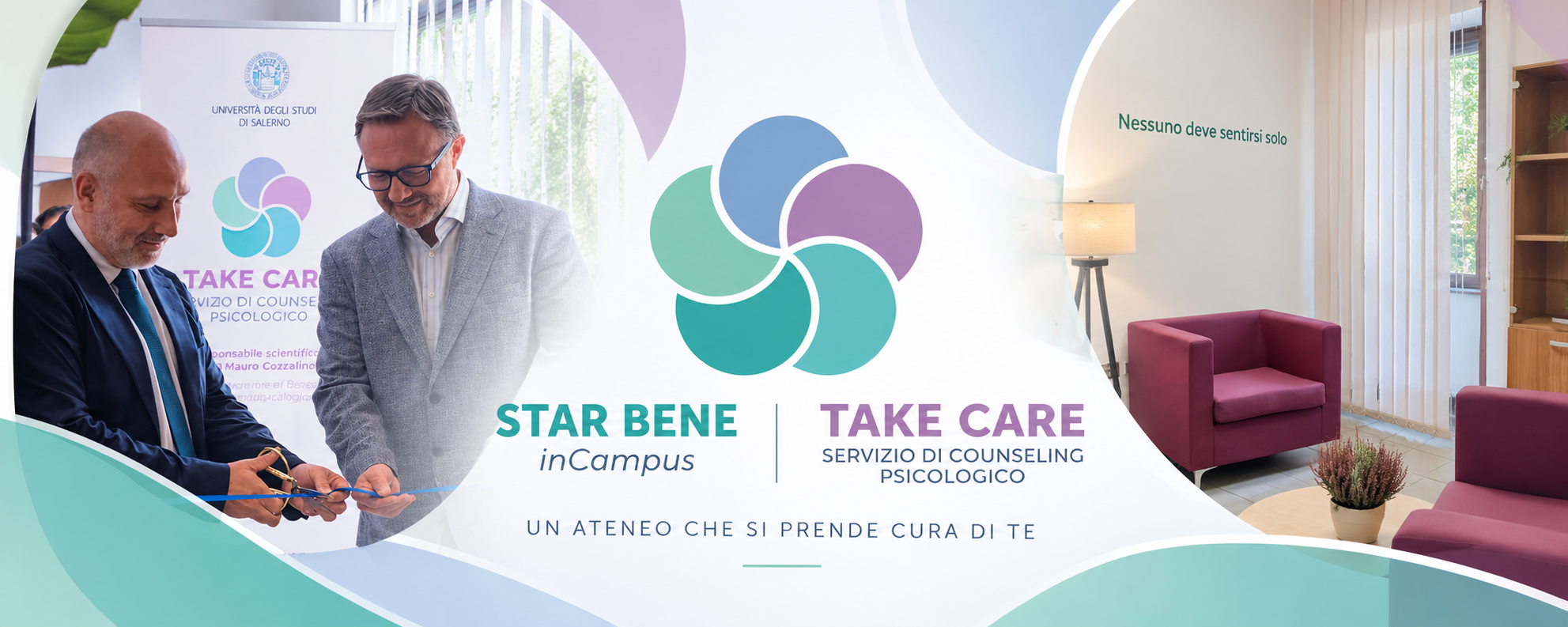
Promoting Diversity & Inclusion also means creating a university environment where no one feels alone when facing difficulties and where seeking support is simple, accessible and free from stigma. This is the vision behind Star Bene inCampus and Take Care, the integrated system developed by the University of Salerno to promote psychological well-being and prevent psychological distress.
Within Work Package 3 – Diversity & Inclusion of the European University Alliance NEOLAiA, the initiative has been identified as a new UNISA Best Practice. To explore it further, we interviewed Professor Mauro Cozzolino, Full Professor of Clinical Psychology and Rector’s Delegate for Well-being and Psychological Counselling, who has led the development of the initiative. The new University Psychological Counselling Service Take Care was officially inaugurated on 19 October 2026.
Preventing distress by promoting well-being
The initiative responds to the growing psychological distress observed among students and, more broadly, across the university community. However, its purpose is not simply to intervene once a situation has already become critical.
As Cozzolino explains, “promoting well-being and preventing distress are two sides of the same coin.”
Star Bene inCampus therefore includes awareness-raising initiatives, seminars, experiential groups and new well-being activities offered free of charge to students and staff. Alongside these preventive actions, Take Care provides psychological support when more significant difficulties emerge.
Reducing stigma is a crucial part of this approach. Opening a counselling service is not enough: people also need to trust it, feel welcomed and understand that experiencing a difficult period should not automatically be associated with pathology.
Building a community-based support network
To bring well-being initiatives closer to everyday university life, UNISA has introduced Departmental Well-being Representatives, creating a two-way connection between the central university level and individual departments and degree programmes.
They will work alongside Student Well-being Promoters: selected and trained students who can raise awareness among their peers, help reduce stigma and make it easier for students to approach available support. UNISA has established 40 scholarships for this role.
Cozzolino summarises the underlying philosophy in one sentence: “No one should ever feel alone.”
Support that adapts to the person
Take Care follows a Stepped Care model. Through an initial self-assessment based on evidence-based tools, users can gain greater awareness of their well-being and be guided towards the most appropriate level of support, from psychoeducational resources and experiential groups to individual or group counselling.
The principle is straightforward: “the intervention must adapt and be personalised”, rather than expecting the person to adapt to the service.
Accessibility also includes remote counselling for working and non-attending students and the possibility of receiving support in English. This is particularly relevant for international students, who may experience isolation as well as cultural, linguistic and distance-related challenges.
A Best Practice for NEOLAiA
Star Bene inCampus and Take Care stand out as a D&I Best Practice because they combine prevention, proximity, student participation, accessibility and personalised support.
The initiative ultimately reflects a simple principle: an inclusive university should not merely provide services—it should create the conditions for every member of its community to know that, when support is needed, someone is there.