1. Could you briefly introduce yourself and describe your role at the University of Salerno?
My name is Mariarosaria Colucciello, Full Professor of Spanish and Latin American Language, Translation and Culture at Department of Political and Communication Sciences at the University of Salerno. Since 2024, I have been the Rector’s Delegate for Mobility Policies and, as part of this role, I am responsible for promoting and strengthening international mobility amongst students, academic staff and technical and administrative staff, whilst contributing more broadly to the University’s internationalisation strategies. I am also the NEOLAiA Delegate for my Department, a role that enables me to closely monitor the opportunities for academic, teaching and scientific cooperation offered by the Alliance and to promote these within our university community.
2. When and where did you undertake the mobility? What motivated you to take part in this mobility experience?
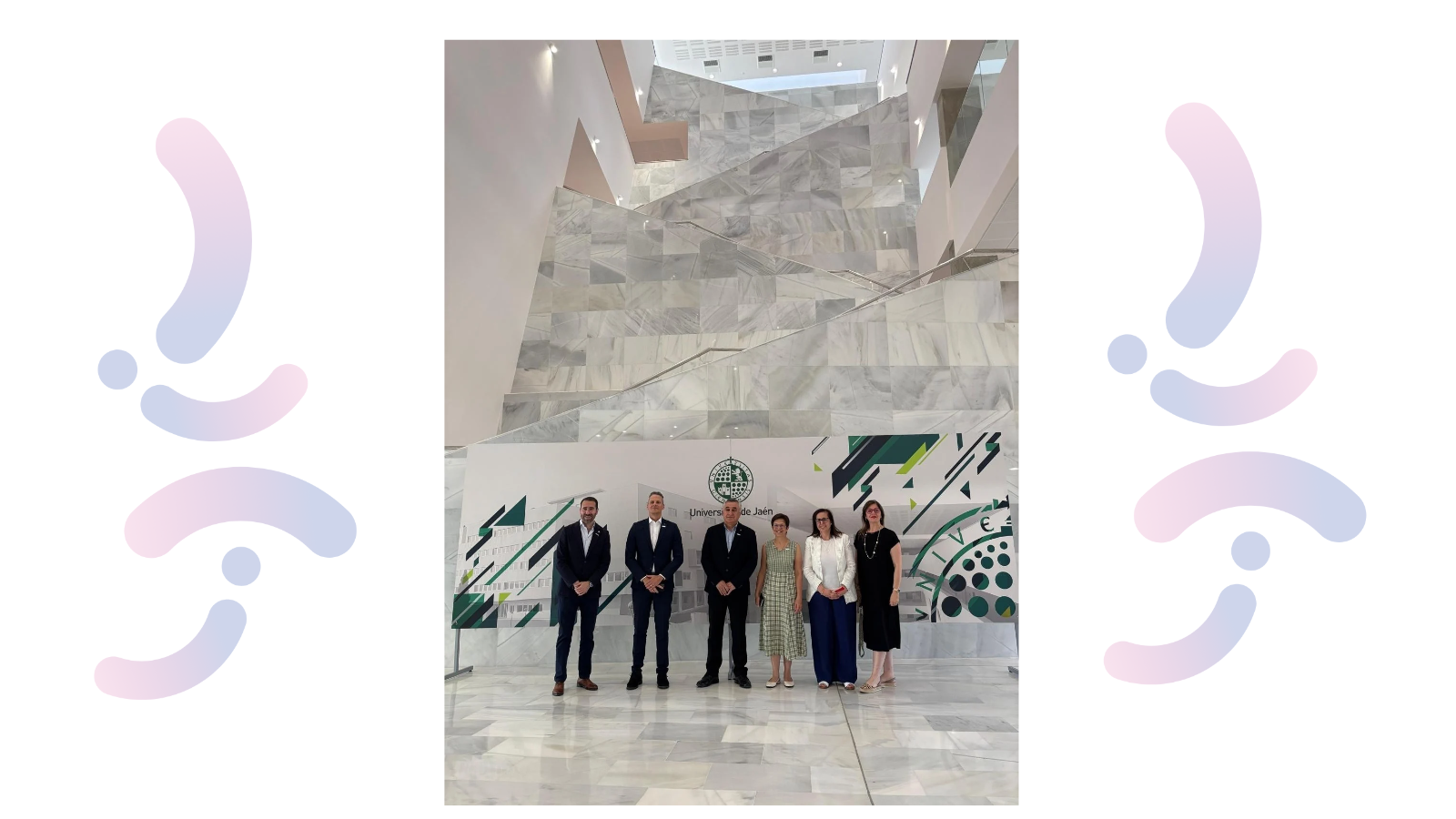
I undertook an exchange programme at the Universidad de Jaén during the Second NEOLAiA International Symposium on Language Policy, EMI and Plurilingualism for Global Higher Education (18-20 June 2026), taking part in the round-table discussion for those responsible for internationalisation at the Alliance’s universities.
The main reason for this was the opportunity to exchange views with colleagues from other NEOLAiA universities on a topic I consider to be closely linked to mobility policies and, more generally, to the internationalisation of higher education: the relationship between language policy, multilingualism, English-Medium Instruction (EMI), inclusion and international mobility.
The Symposium also provided an important opportunity to reflect on the situation at the University of Salerno. UNISA remains a predominantly Italian-speaking university, particularly at the level of three-year degree programmes, but in recent years it has seen significant growth in internationalisation through Erasmus mobility, dual degrees, international partnerships and an increasing use of English in master’s programmes, research and international cooperation.
Taking part in the Symposium therefore meant not only presenting Salerno’s experience, but above all comparing it with the models, practices and strategies developed by the Alliance’s other partners.
3. What did you find most enriching about the experience, both professionally and personally?
The most enriching aspect was undoubtedly the direct exchange with colleagues from different university systems and linguistic contexts, yet united by the need to rethink the role of languages in the contemporary European university.
The dialogue that took place in Jaén demonstrated very clearly that internationalising a university does not simply mean increasing the number of courses taught in English. English naturally remains an essential tool for mobility, scientific cooperation and international visibility, but it must form part of a broader perspective capable of promoting multilingualism, linguistic diversity and intercultural skills. This is a particularly significant aspect of the approach promoted by NEOLAiA: EMI is not conceived as a substitute for national languages, but as part of a more inclusive and diversified language strategy.
From a personal point of view, I found it very inspiring to see how the Alliance is gradually building a genuine European academic community. In-person meetings, in fact, allow us to go beyond formal exchanges between institutions: they enable us to get to know one another, share challenges and best practices and, above all, foster ideas and collaborations that can continue even after the mobility programme has ended.
4. How do you think you will be able to apply what you learned during the mobility experience to your work, whether in teaching, research or other activities?
This is probably the area in which Jaén’s experience can have the most tangible impact.
The discussions at the Symposium have reinforced my conviction that language policy should be regarded as a structural component of the University’s internationalisation strategies, rather than merely a linguistic issue. For UNISA, one possible approach could be to promote ever-greater coordination between the various bodies involved – the University’s governing bodies, internationalisation offices, the University Language Centre, departments, academic and technical-administrative staff, and student representatives, including international students – in order to make existing initiatives more cohesive. In my speech in Jaén, I had also suggested, amongst other possible actions, the establishment of a University Commission or Task Force dedicated to language policy.
It is equally important to invest in the language and methodological training of lecturers involved in EMI, in language support for administrative staff, and in the development of intercultural skills across the entire academic community.
Another lesson I have taken away concerns internationalisation at home. Not all students have the opportunity to undertake physical mobility, and the international experience must therefore also be brought into our classrooms and onto our campuses through COIL, virtual exchange, multilingual classes, language tandems, intercultural events and peer mentoring programmes. These are tools capable of extending the benefits of internationalisation to a much wider audience of students.
In this regard, UNISA already has significant initiatives in place, such as the Buddy System, and the work carried out within NEOLAiA can enable us to strengthen these and align them more closely with the practices of the other universities in the Alliance.
5. Would you advise your colleagues to take part in a mobility programme at NEOLAiA universities? If so, why?
Absolutely. I believe that mobility within NEOLAiA has a value that goes beyond the individual educational or scientific experience. It means becoming a real part of a shared European academic space, in which mobility becomes a tool for building lasting relationships between people, departments and institutions.
The opportunity to meet colleagues working on similar issues, but within different academic and cultural contexts, allows us to view our own university environment from new perspectives, to identify transferable best practices and to envisage joint initiatives.
It was in Jaén that we discussed simple yet sustainable forms of collaboration between the Alliance’s universities: shared language courses, multilingual language tandems, virtual exchanges, COIL projects, intercultural workshops and blended mobility. The aim is to ensure that cooperation involves not only students, but also lecturers and technical and administrative staff.
For this reason, I would certainly advise colleagues to take advantage of the mobility opportunities offered by NEOLAiA. Every mobility experience can become not only a personal growth experience, but also the starting point for new educational and research collaborations and stronger institutional ties between our universities. It is precisely through these exchanges that a European Alliance ceases to be merely a network of institutions and gradually becomes a genuine community of people, knowledge and shared practices.