1. Could you briefly introduce yourself and describe your role at the University of Salerno?
My name is Erika Marie Pace. I am of Maltese origin, and I have always had a strong interest in engaging with people from different backgrounds, as well as with different cultures and perspectives. I am an Associate Professor of Teaching and Special Education at the Department of Humanities, Philosophy and Education (DISUFF) at the University of Salerno.
For about ten years, I have been actively involved in committees dedicated to internationalisation, and I currently serve as the Internationalisation Delegate for the Educational Area of Education for Inclusion and Well-Being. Since 2024, I have also served as the NEOLAiA Delegate for DISUFF.
These responsibilities, alongside the numerous collaborations developed through my research activities, have allowed me to strengthen international academic networks and promote opportunities for mobility, exchange, and collaboration for both students and faculty members.
2. What motivated you to take part in this mobility experience?
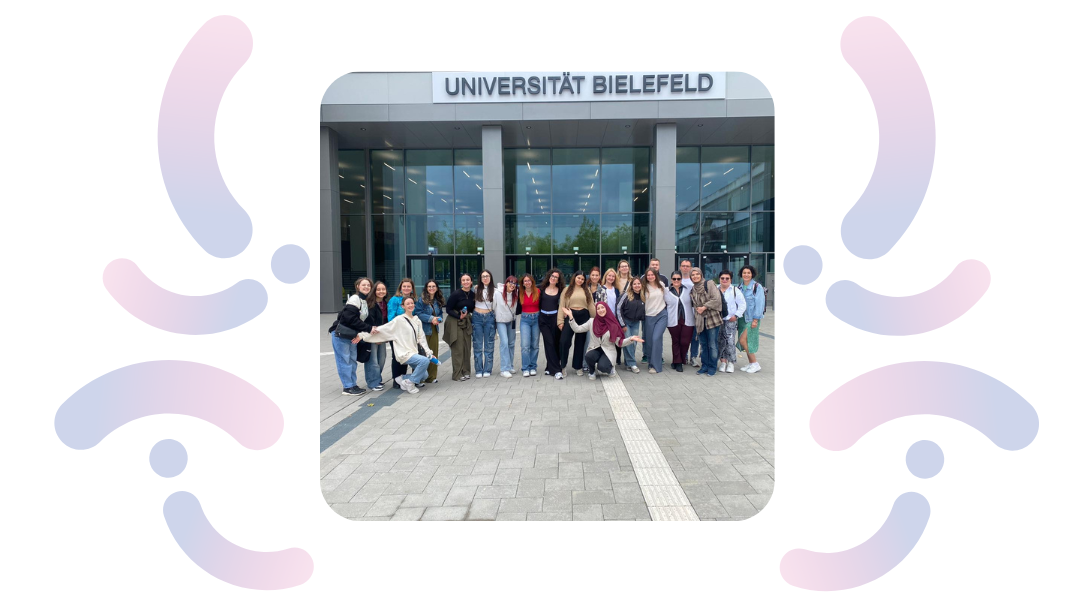
The experience of the Blended Intensive Programme, “Breaking the Bubble: A Course on Comparing Educational Systems Worldwide,” with the University of Bielefeld originated from a collaboration with my colleague from the Department of Business Sciences – Management & Innovation Systems, Professor Bice Della Piana. She had previously invited me to join the “Diversity and Inclusion” Work Package and, at a later stage, encouraged me to consider this opportunity for DISUFF students as well, given its close connection with the topics addressed in our courses and, more specifically, in my teaching activities.
I had also already had the opportunity to meet my colleagues from the University of Bielefeld on previous occasions, during exchanges and discussions within the NEOLAiA alliance.
The opportunity to take part in an experience of this kind seemed particularly interesting to me, both because of the highly relevant and timely topics addressed and because of their strong connection with the students’ educational pathways. I therefore saw the programme as an opportunity to broaden the comparison with other educational systems while, at the same time, offering the participating students a learning experience that could combine the academic dimension with an international and intercultural perspective.
3. What did you find most enriching about the experience, both professionally and personally?
From a professional perspective, the experience allowed me to strengthen relationships that had already been established within NEOLAiA and to further engage with colleagues from different university contexts. This exchange was particularly meaningful because it provided an opportunity to bring together different approaches, perspectives, and teaching practices, offering new insights and points for reflection also in relation to the topics addressed in my courses. In this sense, the BIP represented a natural continuation of the collaborative work that had already been initiated, as well as a further opportunity to strengthen the international dimension of teaching and research.
On a personal level, one of the aspects I appreciated most was the opportunity to share the experience with students in a context different from the usual university classroom. Spending more time together encouraged a more spontaneous and direct exchange and allowed me to gain a deeper understanding of their perspectives, not only regarding their academic journey, but also their expectations, challenges, and experiences as university students.
This was a particularly enriching aspect of the experience, as it made the teacher-student relationship more genuine and reinforced my belief in the value of mobility experiences, which goes far beyond strictly academic content. They create opportunities for mutual understanding, personal connection, and the development of meaningful relationships.
4. How do you think you will be able to apply what you learned during the mobility experience to your work, whether in teaching, research or other activities?
The BIP also had an impact on my research and future international collaborations, contributing to the development of further opportunities for exchange among institutions, faculty members and students. In this sense, the mobility experience was not self-contained, but became part of a broader process aimed at making university teaching increasingly international, open to dialogue, and focused on exchange.
The experience also provided me with new ideas for addressing certain topics within my courses. In particular, I would like to apply what I observed and experienced during the BIP to designing more practical, participatory and active learning activities that engage students directly.
My goal is to provide learning experiences that transcend the traditional classroom setting, offering opportunities for dynamic learning based on dialogue, collaboration, and engagement with diverse contexts and perspectives.
5. Would you advise your colleagues to take part in a mobility programme at NEOLAiA universities? If so, why?
Absolutely! It is definitely worth it. Organising and planning a mobility experience, together with the natural sense of responsibility towards the students, can be very time-consuming and energy-intensive. You may also initially hesitate because you may not know your future colleagues very well, you may not know exactly how much time the experience will require, and you may wonder whether you will be able to meet expectations. You also have the responsibility of ensuring that the mobility experience is genuinely positive and enriching for the students.
However, I believe that these aspects can be seen as driving forces rather than limitations. The professional, human and interpersonal growth you experience more than makes up for the effort involved.
NEOLAiA mobility experiences provide opportunities to engage with different contexts, people and perspectives, and to build relationships that often continue well beyond the individual experience