1. Could you briefly introduce yourself and describe your role at the University of Salerno?
I am an Associate Professor at the University of Salerno, where I am affiliated with the Department of Humanities, Philosophy and Education and a member of the “Teaching Learning Center for Education and Inclusive Technologies – Elisa Frauenfelder” Laboratory.
I also serve as Secretary and a member of the Board of Directors of SIREM – the Italian Society for Media Education Research. In addition to that, I am the Editor-in-Chief of the International Journal of Virtual and Augmented Reality (IJVAR), published by IGI Global, and a member of the Technical Committee of the IEEE Consumer Technology Society (CTSoc), where I focus on Virtual Reality, Augmented Reality, and the Metaverse (VAM).
My academic and professional background is rooted in technology. I hold a degree in Computer Engineering from Politecnico di Milano and subsequently completed a joint master’s degree at the University of Illinois Chicago. Since then, my research and professional activities have focused on the complexity of human–computer interaction in education, the teaching and learning process, and inclusive technologies.
2. What motivated you to take part in this mobility experience?
My participation in this mobility experience is part of an academic and scientific collaboration that I have been developing in Cyprus for several years. Over time, I have had the opportunity to establish relationships with several Cypriot higher education institutions, including the University of Nicosia.
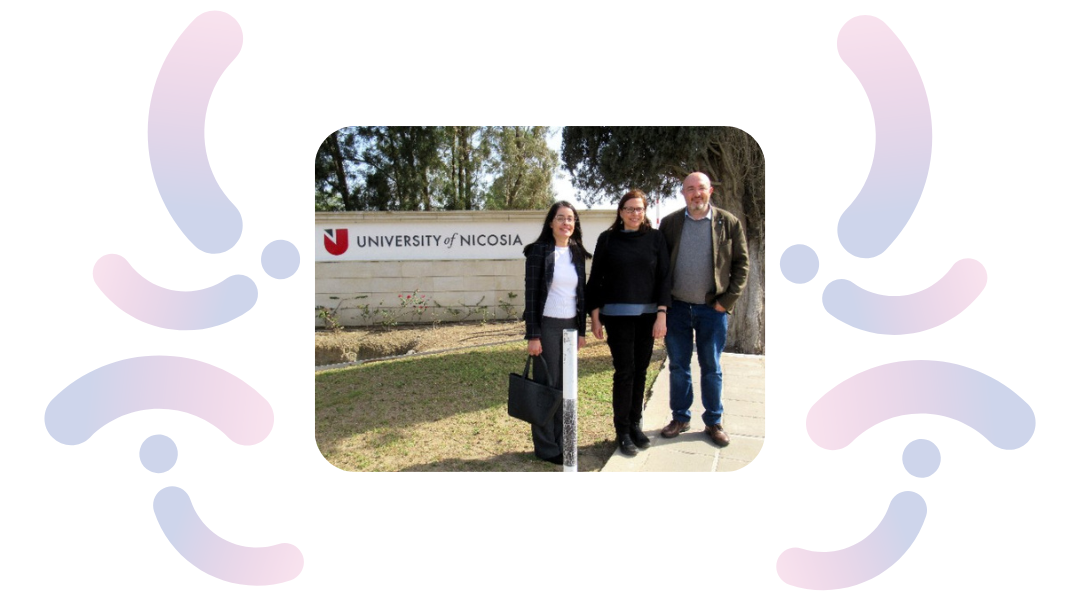
I have already undertaken several mobility experiences at the University of Nicosia under the University of Salerno’s Erasmus+ Staff Mobility for Teaching agreements, in March 2024, May 2025, and February 2026.
These experiences have fostered the development of scientific collaborations with colleagues from the School of Education, which have also resulted in joint publications, particularly on topics related to museum education and font accessibility for people with dyslexia.
3. What did you find most enriching about the experience, both professionally and personally?
Cyprus represents a particularly meaningful context for me, both culturally and academically. It is an island whose culture, traditions, and unique geographical position I deeply appreciate. Historically, its location has made Cyprus an important meeting point between different civilizations and cultural areas.
I have always had a particular interest in Cyprus, also because of its role as the easternmost outpost of the European Union and because of the deep connections that its history and cultural heritage have developed over the centuries with Italy and with the broader Mediterranean context.
This mobility experience therefore represents not only an opportunity for professional growth, but also a valuable occasion for cultural exchange and personal enrichment.
4. How do you think you will be able to apply what you learned during the mobility experience to your work, whether in teaching, research or other activities?
The knowledge and professional relationships developed during the mobility experience can be directly transferred to my research and teaching activities, first and foremost by strengthening international scientific collaborations and developing new joint publications.
These experiences also represent an important opportunity for the growth of the research group and, in particular, for the PhD students who collaborate with the research team to which I belong. They provide an opportunity to share with them the methodologies, perspectives, and opportunities for academic exchange gained within an international higher education context.
5. Would you advise your colleagues to take part in a mobility programme at NEOLAiA universities? If so, why?
Absolutely. I believe that international mobility is one of the fundamental dimensions of the university experience, as it provides an opportunity to engage with different approaches, methodologies, and perspectives, while also fostering the development of academic and scientific networks.
In this sense, mobility is rooted in a long-standing tradition in the history of European universities. As early as the Middle Ages, students and scholars travelled from one city to another to broaden their knowledge, meet other scholars and teachers, and exchange ideas and knowledge.
Even today, this tradition remains highly relevant and can translate into concrete opportunities for collaboration, internationalization, and innovation in both research and teaching