
The Blended Intensive Programmes (BIPs)
Blended Intensive Programmes (BIPs) are intensive courses that adopt innovative methods of learning and teaching, including online cooperation. BIPs offer added value compared to the existing courses of the participating institutions and can also be multi-annual.
These programmes combine physical and virtual mobility with the aim of engaging students from all backgrounds, fields of study, and educational cycles. Higher education institutions can organize short blended intensive programmes for the learning, teaching, and training of students and staff.
During BIPs, participants undertake short-term physical mobility abroad, integrated with a compulsory virtual component that facilitates online collaborative learning and teamwork on specific learning objectives.

Blockchain Application Development (BAD)
📆 October 05-09, 2026 (on-site in University of Salerno – Department of Computer Science)
📍 University of Salerno – Department of Computer Science
🏣
The BIP programme combines five days of in-person sessions with one month of distance learning, focusing on the design and development of blockchain applications geared towards security, privacy protection and digital identity management, featuring use cases and live, guided practical workshops.
The distance learning component will help to standardise the initially varied skill levels of the learners. The seminars and hands-on activities will provide a practical framework..
Learners will complete case studies in teams, contributing to the drafting of a final presentation
More information are here.

NEOMentor: Diversity and Inclusion Student Training
📆 September 21-25, 2026
📆 October-November , 2026 (on-site in Bielefeld University (Germany))
📆 April 2027
📍 Bielefeld University (Germany)
More information are here.

Security-Aware Software Architecture (SASA)
Blended Intensive Programme (BIP) – Security-Aware Software Architecture (SASA), organized within the framework of the NEOLAiA European University Alliance, focuses on the design and evaluation of software architectures with integrated security.
The course covers fundamental concepts of software architecture, architectural patterns, and quality attributes, together with security principles based on the CIAA model. It also includes architectural evaluation methods such as the Architecture Tradeoff Analysis Method (ATAM), as well as modeling and documentation techniques using UML and component diagrams.
More information are here.

Eyes Wide Open: Learning to see possible inclusive worlds
📆 May 18-23, 2026 (on-site activity in Nicosia)
📆 November -December 2026 (Online activities)
📍 University of Nicosia, Cyprus
The Blended Intensive Programme (BIP) “Eyes Wide Open: Learning to See Possible Inclusive Worlds”, organized by the University of Nicosia, invites students to explore diversity and inclusion through artistic, visual, and reflective approaches. The programme aims to develop global competences, critical and creative thinking, and intercultural collaboration skills through art-based learning and visual inquiry practices.
Combining online activities (March–May 2026) with a one-week physical mobility period in Nicosia (18–22 May 2026), the course promotes an understanding of cultural biases, the use of visual languages for inclusive communication, and the design of innovative educational interventions.
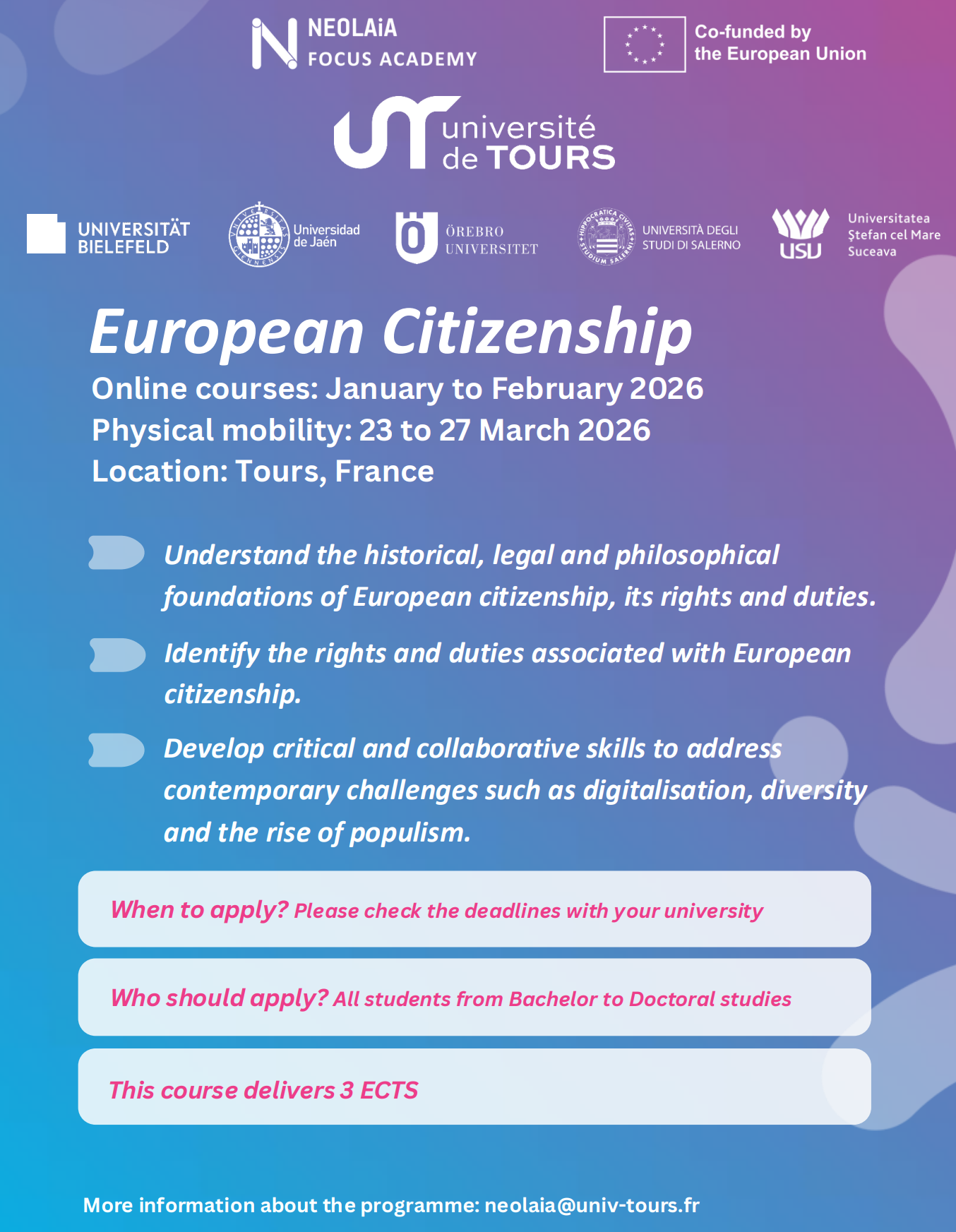
NEOLAIA Focus Academy – European Citizenship
📆 March 23 – 27, 2026
📆 November -December 2026 (Online activities)
📍 University of Tours, France
The Blended Intensive Programme (BIP) “NEOLAIA Focus Academy – European Citizenship”, organized by Université de Tours, explores the historical, philosophical, and legal foundations of European citizenship, examining its connections with democracy, diversity, and digital transformation.
Through lectures, seminars, practical activities, and simulations, students will analyze the rights and responsibilities associated with European citizenship, the functioning of EU institutions, and the impact of digitalization on democratic participation. The programme also includes the creation of podcasts and participation in a serious game that simulates the European decision-making process.
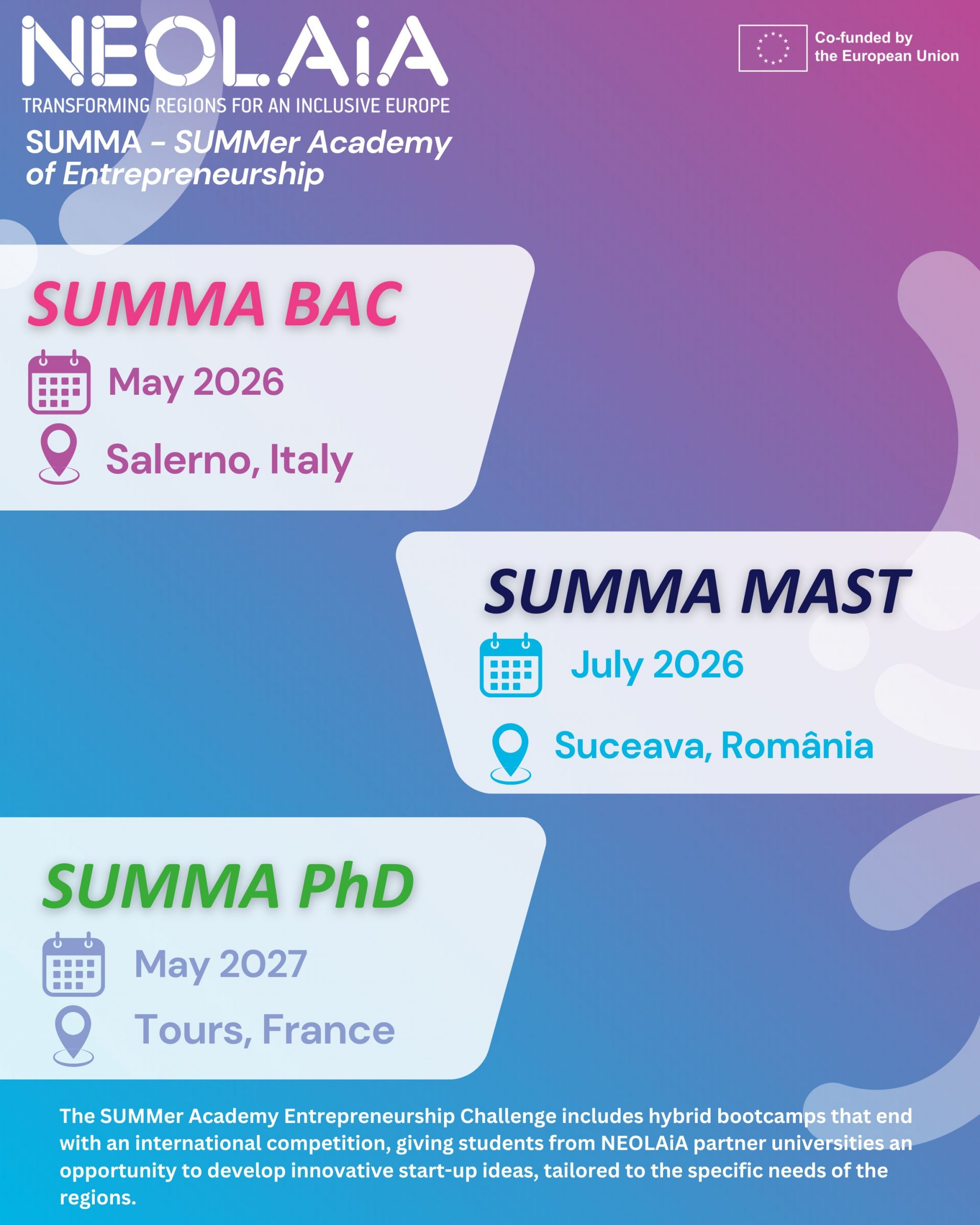
SUMMA MAST / SUMMer Academy for MASTer Students
📆 June 01 – July 31 2026
📍 “Stefan Cel Mare” University di Suceava, RO
The NEOLAiA Hybrid BIP Hackathon is an international co-creation programme designed for students from the nine partner universities of the NEOLAiA Alliance. The programme combines online and in-person activities to guide participants through the entire innovation process: from identifying local challenges and analysing problems, to generating innovative ideas, developing sustainable business models, and presenting final business plans.
Through teamwork, mentoring, and experiential learning, students will co-design entrepreneurial solutions aimed at enhancing local communities and promoting sustainable development.
More information about the application procedures for this BIP is available here.
Introduction to Information Security Requirements
📆 June 2-13, 2026 (online)
📆 June 15-19, 2026 (on-site in Nicosia, Cyprus)
📍 University of Nicosia, Cyprus
This second edition of the BIP course enables students to gain a solid understanding of information security requirements, with a particular focus on their definition and elicitation for security solutions. The added value of the programme lies in its vertical approach to information security requirements engineering, addressing key concepts, processes, and tools. Students will develop basic skills to identify, analyse, and model information security requirements using established requirements engineering modelling techniques.

Introduction to Information Security Requirements
 January 20 – February 9, 2025 (online and on-site)
 Örebro University, Sweden
Learn how to analyse and evaluate information security requirements and to communicate these requirements with other relevant actors in the system development life cycle.
More information about application and benefits of this course are here.

Global Competencies and Multicultural Identity
3 – 7 November, 2025 Siauliu Valstybine Kolegija” (SKV) – Siauliai (Lituania)The BIP programme focuses on diversity in learning styles and multicultural identities, promoting inclusion through self-directed learning, the development of entrepreneurial skills, and the enhancement of creativity. Its objective is to equip students with essential global competencies for career planning and success in an ever-evolving job market.
The course awards 2 ECTS credits (50 hours of virtual activities) and 1 ECTS credit (25 hours of on-site activities). It includes workshops, asynchronous learning activities, cooperative learning, and 33 hours of individual work dedicated to analysis, reflection, and the completion of assigned learning tasks.
SUMMA MAST / SUMMer Academy for MASTer Students
📆 2–13 June 2025 (on-site component)
📍 University of Ostrava, Czech Republic
Its main objective is to enable digital technologies to support the preservation of the memory of vanished places, monuments, communities, and visual objects, while reconstructing their multi-layered digital history and reconnecting it with the present.

SUMMA MAST / SUMMer Academy for MASTer Students
📆 13–19 June 2025 (on-site component)
📍 Ștefan cel Mare University of Suceava, Romania
The Blended Intensive Programme (BIP) “NEOLAiA Hybrid BIP Hackathon – SUMMA MAST”, hosted by the University of Suceava (Romania), is an international co-creation programme designed for master’s students from the NEOLAiA partner universities. The programme guides participants through the entire entrepreneurial innovation process, from identifying local challenges and defining problems to developing sustainable business models and presenting final business plans.

Breaking the bubble: A course on comparing educational systems worldwide
June 9–20, 2025 (online) 30–July 4, 2025 (on-site at Fisciano Campus of the University of Salerno, Italy) Fisciano Campus of the University of Salerno, Italy
The BIP offers a course that invites students to explore the educational systems of different countries, broadening their understanding of diverse global perspectives. It provides an opportunity to compare and analyse how education is structured and managed internationally. The programme aims to familiarize students with different education systems around the world, fostering an understanding of the cultural value of education and its impact on inclusive educational practices.
Based on a collaborative teaching approach, the course includes small-group discussions, hybrid exchange sessions, and engagement with international experts who will provide feedback on students’ project proposals.
The dedicated page on the University of Salerno (UNISA) website is available here.
Personal Health Data Management
June 9–20, 2025 (online)
30–July 4, 2025 (on-site at Fisciano Campus of the University of Salerno, Italy) Fisciano Campus of the University of Salerno, ItalyLearn how to
- Model, process, and visualize health data.
- Address privacy and security concerns under GDPR.
- Develop effective digital health solutions with a human-centered
approach.
Participants will work collaboratively across disciplines such as computer science, healthcare, and management, ensuring a comprehensive learning experience.
More information about application and benefits of this course are here.